
Orange County Previous Residents Sources
The source trail for Orange County past residents has uneven eras. Begin with the present parcel or SBL and work backward through the most recent deed. Then choose the source that fits the period in question. Deeds establish recorded transfers; directories and census schedules can supply period household clues; maps and permits help establish the address and building context. The table separates those functions so an old map or a listed name is not asked to prove more than it can.
| Source | Years It Covers | Where Held | What It Shows |
|---|---|---|---|
| FamilySearch deed books and indexes | 1703-1900 | FamilySearch and Orange County Clerk historical routes | Grantor, grantee, recording details, legal descriptions, book or image references, and transfer sequence. |
| FamilySearch mortgages and indexes | 1703-1869 | FamilySearch and County Clerk series | Borrower, lender, lien, assignment, or satisfaction. A mortgage alone does not prove possession. |
| Orange County state census books | 1825-1875 | County Clerk Record Room, not online | Period household and municipality enumeration in the county books. |
| Newburgh directories | 1860s onward | Newburgh Free Library, Historical Society, and other library holdings | Name, address, and edition-specific household clues; address work is strongest in later indexed volumes. |
| Federal census | 1790-1950 open | National Archives and genealogy repositories | Names, ages, relationships, birthplace, and later address fields where the schedule supplies them. |
| Sanborn map examples | Goshen 1900/1915; Port Jervis 1900; Walden 1913 | Library of Congress and repositories | Building footprint, material, use, street layout, and period context, not ownership. |
For the newest documented transfer, start with the clerk index and assessment record. For a nineteenth-century address, FamilySearch deeds, county census books, and early Newburgh directory volumes may all be relevant. The Record Room is the route when an online catalog stops; it holds historical census books, old atlases, naturalizations, maps, and court material. FamilySearch requires a free account, and some images may be available only at a partner or library location.
Orange County Past Residents Deeds
Orange County has a useful long deed era, but it is divided across systems. The County Clerk historical page directs researchers to FamilySearch deed grantor/grantee indexes and deed books A-450 from 1703 through 1900. Remote SearchIQS coverage can extend beyond that period, but the exact cutoff varies by record series. SearchIQS is linked from the Clerk's Online Records page; free public computers are available at the County Clerk / Record Room for work that cannot be completed remotely.
The Record Room offers a second access channel for a historical book, certified copy, or series absent from a screen. Plain copies are listed at $0.65 per page with a $1.30 minimum, and certified copies at $1.25 per page with a $5 minimum. Mail requests need the record details, payment by the listed methods, and a self-addressed stamped envelope. The Clerk's 255 Main Street, Goshen office lists record-room and certified-copy contact at 845-291-3287.
Do not assume a remote result is the entire document. Capture the document number, recording date, document type, parties, municipality, legal description or parcel reference, book/page or image link, and cross-references. Read the image for the description, signatures, restrictions, easements, and transfer language.
Trace Orange County Previous Residents
To trace Orange County prior residents through property ownership, start from the current assessment record and walk backward one recorded transfer at a time. The assessor's owner display is a lead, not the finished trail. Preserve the parcel/SBL, municipality, situs address, mailing address, and legal description. The legal description is especially useful when a road name or number has changed.
- Find the current parcel in Orange County Parcel Information. Copy the owner display, parcel or SBL, municipality, and legal-map details.
- Search the current owner as grantee in the Clerk's recorded land index and locate the purchase deed using the parcel and legal description to distinguish similar names.
- Record the seller, or grantor, from that deed. Search that seller as the next earlier grantee to locate the preceding acquisition.
- Repeat the seller-as-next-grantee method, checking organization, trust, estate, married-name, initial, and spelling variants. Keep every document number and date in order.
- When the online chain ends, move to the Record Room, FamilySearch browse images, microfilm, or the relevant historical repository. Do not fill a gap with an assumed transfer.
- Grantor / grantee
- The grantor transfers an interest in the document; the grantee receives it. In the backward method, the seller from one deed becomes the next earlier grantee to search.
- Chain of title
- The ordered sequence of recorded transfers and related land documents tied to the same legal parcel.
- Legal description
- The subdivision, lot, or metes-and-bounds language that identifies the land more reliably than a changing street address.
- Criss-cross directory
- An address-oriented directory arrangement that can connect an address with a listed name in a particular edition.
- Enumeration district
- The census geography used to organize an enumeration. It can help find the right schedule when an address and city label differ.
Orange County House History Maps
Sanborn maps are building evidence, not person evidence. The documented local examples are Goshen 1900 and 1915, Port Jervis 1900, and Walden 1913; a Montgomery 1937 collection record was found but not online. A sheet can show whether a structure stood at the site, its footprint, construction material, use, and street layout during the mapped period.
Pair a Sanborn result with the deed legal description, directory number, tax photograph, and municipal building file. An old footprint does not establish that the same building or number survived unchanged. When a lot has been subdivided or consolidated, compare the old lot or block with the current parcel map and neighboring lots before matching a name to the address.
Municipal permit and certificate files provide another physical-history route. No countywide online run was located. Ask the relevant Middletown, Port Jervis, city, town, or village building department for its procedure and request the original permit, alteration permits, certificates, repair or demolition records, code notices, and final inspection by both current and former address forms.
Orange County House History Photos
Newburgh adds a particularly useful house-history layer to Orange County research. The Newburgh Heritage Collection includes 1916 assessment photographs and documents more than 1,300 buildings photographed or otherwise recorded during 1958-66 Urban Renewal. These materials can show façade, neighboring structures, street context, or a building that later disappeared from a modern map.
Start with the Newburgh Historical Society house-history guide when an address falls in the Newburgh context.
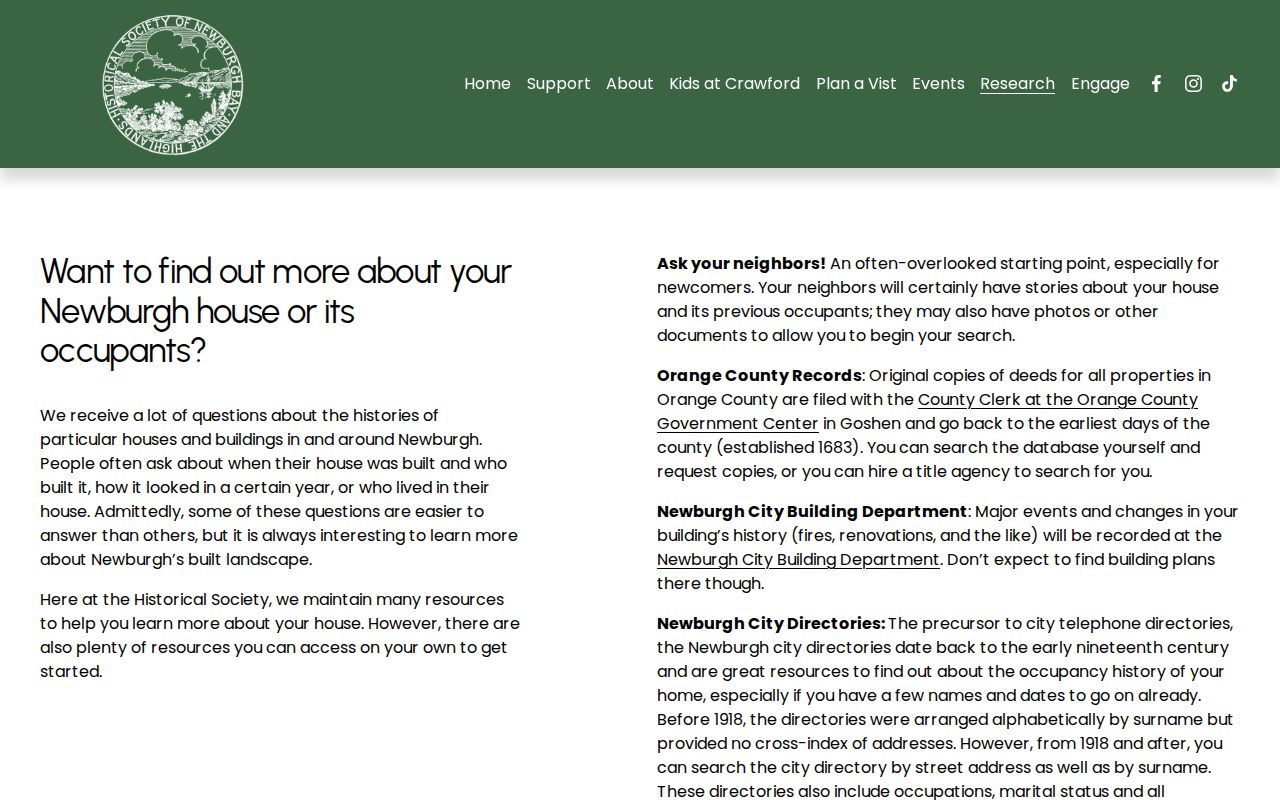
The guide leads back to directories and building-department records rather than serving as an owner index. Connect a photo to a tax map, recorded deed, directory edition, or city assessment entry before drawing a conclusion about a particular address.
Newburgh Free Library's local-history resources also include books, clippings, telephone directories, maps, and the assessment and urban-renewal material. New York Heritage provides a digital route for historic images and documents, while a visit or a focused request may be needed for the underlying local item.
Orange County Past Address Forms
Address continuity is the common weak point in a previous-residents search. No authoritative countywide 911 renumbering year was found. In Newburgh, the 1935 Newburgh Streets - Names and Origin, compiled by city clerk Daniel J. Coutant and Anna Templeton, can bridge a modern road name to an older local label. It should be used as a research lead, not as proof that every number stayed the same.
Record both old and current street forms. Search the name with a surname, neighboring house numbers, the parcel map, and the legal description. Newburgh Historical Society notes that pre-1918 directories are generally surname-alphabetical without a street cross-index, while 1918 and later volumes can be searched by surname and address. That difference changes the order of the search: older periods may require a name first, while later books can support address-first work.
The County's boundary history matters too. Orange County was established in 1683, and Rockland separated in 1798. A pre-1798 record can describe a place now outside Orange County. Preserve the source's historical place label, then map it to the modern municipality without overwriting the original wording.
Orange County Historic Households
Ownership is only one layer of Orange County house-history research. Directories and census schedules can show a dated household clue, but the records need to be paired rather than blended. Newburgh directories reach back to the 1860s. Newburgh Free Library holds telephone books from the 1930s into the early 2000s, while the Orange County Genealogical Society reports incomplete 1899-1956 area runs. Federal census schedules are open through 1950; 1960 and later schedules remain closed under the 72-year rule.
Use this process: address or surname in a directory edition, then the next available directory, then the nearest open federal census, then the county state census book for 1825-1875 where it applies. Compare spelling, spouse or relationship notation, street number, and municipality. The records can point in the same direction, but a directory gap must remain a gap rather than an assumed continuous stay.
For the underlying runs and reading a directory entry, consult the Orange County Directory Book. The search may also require Newburgh Free Library, Newburgh Historical Society, Orange County Genealogical Society, NYS Library microfilm, or the County Clerk Record Room. Goshen Public Library offers local-history research at $15 per hour plus postage, with copies listed at $0.25, for a focused request that cannot be completed online.
Lawful use. Orange County house-history research is for family history, property history, civic curiosity, and personal research. Do not use findings to stalk, harass, or harm a living person.
Orange County House History Help
Obituaries, probate, and historical collections can close an address story without proving every move between records. An obituary may give a former town, surviving spouse, funeral home, cemetery, or a date to test against the next directory edition. The WebSurrogate index can identify an estate file, executor or heir relationship, and file number where the court record is public; older or paper files follow court rules and may require a request.
Verify an obituary index against the newspaper image or funeral-home record. Orange County research routes also include old atlases, naturalizations, church records, and cemetery sources, which can explain a parcel's institutional or immigrant history when the deed chain is hard to read. A narrow request should name the municipality, legal description, date span, and record type rather than asking for every record tied to an address.
Note: Treat a historical address as a dated clue, and record the source, page or file number, and period before connecting it to another household record.